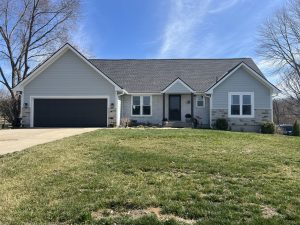
Drive around Overland Park or the Kansas City Metro, and you’ll see homes that mix siding materials two different ways. Some have a transition near the roofline that looks clean and intentional, almost like it was always one surface. Others have a line that looks chopped off, boxed in, like two separate projects. Most homeowners can’t say why. It usually comes down to one small trim decision most people never learn the name of.
Yes, You Can Mix Siding Materials, If It’s Done Right
Combining lap siding with shake shingle or board and batten is one of the most effective ways to add depth to a home’s exterior. It’s why the technique shows up so often in gables, second stories, and entryways. Mixing materials done well breaks up a flat facade and draws the eye toward the parts of a home worth highlighting. Done without a plan, though, it can look like an afterthought. The material choice matters, but so does what happens at the seam where the two materials meet. That seam is where most mixed-siding projects succeed or fail.

The Trim Piece Behind the “Boxed In” Look
That seam is usually finished with a trim piece called a band board. It’s a horizontal strip installed anywhere siding changes materials, most commonly where lap siding on the main level meets shake shingle or board and batten up in a gable. Most crews install it automatically, every time, on every transition. It’s not a code requirement or a structural necessity. It’s just the default move, the same way a contractor might always use the same paint sheen unless someone asks for something different.
The Visual Cost of a Default Trim Line
Here’s the problem. A band board takes up vertical space. On a gable that’s already modest in size, a few inches of trim can noticeably shrink how much of that shake or shingle detail actually shows. Instead of one flowing surface from the main wall up into the peak, you get a hard stop, then a strip of trim, then a second material starting fresh. It reads as separated pieces instead of one intentional exterior. On a Kansas City home with a steep roof pitch, that effect is easy to spot once you know to look for it.
How StateLine Handles Lap to Shake Transitions
On transitions from lap siding to shake shingle, StateLine Exteriors skips the band board. The two materials meet directly, creating one continuous line from the base of the home up into the gable. No trim strip breaking up the sightline, no shrunk gable. It’s a small change, but it’s the difference between a mixed-siding exterior that looks assembled from parts and one that looks like it was designed as a whole.
Why the Same Rule Doesn’t Apply Everywhere
This isn’t a blanket “never use a band board” approach, and that distinction matters. On lap siding to board and batten transitions, StateLine still installs the band board. Skip it there and the two materials create a visible hump where the vertical batten lines meet the horizontal lap. That hump is more distracting than any trim line would be. The point isn’t to eliminate band boards. It’s to know exactly which transitions need one and which ones look better without it. That’s a judgment call, not a gimmick, and it only comes from having done enough transitions to know the difference.
One Example of a Bigger Pattern

The band board decision is just one instance of a habit that shows up across StateLine’s siding work. Wherever a trim or separation board is the default but isn’t actually needed, the crew looks for a way to keep the exterior reading as one clean surface instead of a series of segments. Corners, transitions, and material changes all get the same question: does this piece earn its place, or is it just habit? That mindset is part of what earned StateLine Elite Preferred status with James Hardie, a tier reserved for contractors who consistently install to a higher standard than the minimum.
Details You’d Never Think to Ask About
Most homeowners planning a mixed-siding project are focused on color, material, and budget, and rightly so. But small decisions like this one are the kind of thing you’d never think to ask a contractor about, because you don’t know it’s a decision at all. Once you notice a clean, unbroken transition line on your own home, though, you’ll notice it every time you pull into the driveway, and in every photo of the house from now on.
Talk Through the Design Details, Not Just the Measurements
A siding estimate should cover more than square footage and material cost. If you want a consultation that also walks through choices like this one, trim lines, transitions, and how they’ll look on your specific gable, StateLine Exteriors is glad to talk it through. With more than 20 years serving Kansas City, Overland Park, and the surrounding metro, StateLine brings that same eye for detail to every project. Get a quote and see what a fully considered exterior looks like on your home.